

Choose your career options after graduation 2026
Graduation ends and suddenly everyone has an opinion about what you should do next.
Your parents want a government job. Your friends are applying to IT companies. Someone from college is doing an MBA. Another person started freelancing. Your relative is asking why you have not cracked a banking exam yet.
Everyone is confident. Nobody is actually explaining the full picture of what each path involves, what it realistically pays in the first year, and what the growth looks like over five years.
That is what this guide does. No promotion of one path over another. Just an honest look at every major career option available to graduates in India in 2026 — what each involves, what it pays, and who it actually suits.
Why Choosing the Right Career Path Early Matters More Than People Admit
The first two years after graduation shape the next ten years more than most freshers realize.
Not because a wrong choice is permanent — it is not. Career changes happen and people recover from wrong starts all the time. But because switching career directions after two years means starting over in competitive markets that move fast. The fresher who spends two years in a genuinely wrong direction has a harder time entering their right field than someone who identified their direction early and built relevant skills and experience consistently.
This is not meant to create pressure. It is meant to make the choice feel worth taking seriously rather than making the default choice just because everyone around you is doing the same thing.
How to Think About Career Options Honestly
Every career path in India involves a real trade-off between four things — starting salary, growth potential, job security, and quality of life. No single path maximizes all four simultaneously. Understanding what you personally value most makes the choice significantly clearer.
Top Career Options After Graduation in India in 2026
1. Private IT Sector Jobs
Starting salary range: ₹2.5 LPA to ₹6 LPA depending on role and company Growth potential: High — salary can double or triple within 5 years for performers Job security: Moderate — layoffs happen but skilled professionals recover quickly Best suited for: Graduates who enjoy technology, can handle competitive environments, and are comfortable with continuous learning
The Indian IT sector — despite layoffs and hiring slowdowns in recent years — remains one of the largest employment generators for graduates. Companies like TCS, Infosys, Wipro, HCL, and thousands of product and service companies hire graduates across technical and non-technical roles every year.
Non-Technical Roles in IT for All Graduates
Not every IT job requires coding. Business analysts, software testers, technical support executives, IT recruiters, technical writers, and operations staff all work inside IT companies without programming responsibilities. These roles are accessible to any graduate with the right skills regardless of their specific degree subject.
Reality Check on IT Starting Salaries
Entry-level IT salaries in India have not grown as fast as the industry’s reputation suggests. Many graduates joining large IT service companies like TCS and Infosys as freshers start between ₹3.5 LPA and ₹4.2 LPA. Product companies and startups pay higher — sometimes ₹6 LPA to ₹12 LPA for technical roles — but competition for these positions is significantly more intense. Set realistic salary expectations based on your specific skills and target companies rather than general industry figures.
2. Government Jobs
Starting salary range: ₹3 LPA to ₹6 LPA including all allowances Growth potential: Slow but guaranteed — increments are fixed and promotions follow defined timelines Job security: Extremely high — virtually no layoff risk Best suited for: Graduates who value stability, want to stay in their home region, and are willing to invest 6 to 12 months in exam preparation

Government jobs remain the most popular career aspiration for the majority of Indian graduates — and for understandable reasons. The combination of job security, pension, medical coverage, and fixed working hours creates a quality of life that is genuinely difficult to match in the private sector at similar salary levels.
The Time Investment Reality
The primary cost of a government job is not effort during the job — it is effort before the job. SSC CGL, IBPS, state PSC exams, and similar competitive exams require 6 to 12 months of serious preparation. Some candidates take multiple attempts spanning 2 to 3 years before clearing their target exam.
This preparation period — where you are studying full-time with no income — is the real challenge that many freshers underestimate when they decide to pursue government jobs. Plan financially for this period before starting rather than realizing mid-preparation that you need income.
3. Banking Sector — IBPS and SBI
Starting salary range: ₹3.5 LPA to ₹5.5 LPA including allowances Growth potential: Moderate — promotions follow defined timelines with competitive internal exams Job security: Very high — public sector banks have government backing Best suited for: Graduates comfortable with mathematics, customer interaction, and structured work environments
Banking jobs occupy a middle ground between government and private sector. They offer government-level security with private sector-adjacent salary levels and a more dynamic work environment than most traditional government roles.
Bank PO is the most sought-after entry point — it offers faster promotion potential and more responsibility than clerk positions. The exam is competitive but achievable with focused 5 to 6 month preparation for most graduates.
4. MBA — Masters in Business Administration
Investment required: ₹2 LPA to ₹25 LPA depending on college — two years total Post-MBA starting salary: ₹4 LPA to ₹25 LPA depending heavily on college tier Growth potential: Very high at premium colleges — slower at lower-tier colleges Best suited for: Graduates with clear interest in management, marketing, finance, or entrepreneurship who can access a genuinely good college
MBA is the most misunderstood career option in India. At IIMs and top private colleges — XLRI, SPJIMR, MDI — the degree genuinely transforms earning potential and career trajectory. At lower-tier colleges charging similar fees, the degree often does not justify the time and financial investment.
The Honest Truth About MBA in India
The value of an MBA in India is almost entirely determined by the college name. An IIM MBA changes your career. A mediocre college MBA may not. Before spending two years and significant money on an MBA, research your target colleges’ actual placement data — average salary, median salary, percentage placed — rather than believing marketing materials.
If you can crack CAT well enough for IIM or equivalent top colleges, MBA is genuinely worth considering. If the best college you can access has average placements below ₹6 LPA, work experience first and attempt CAT after 2 to 3 years when your profile is stronger.
5. Freelancing and Self-Employment
Starting income: ₹0 to ₹15,000 per month in first 3 months Potential income: ₹30,000 to ₹1,50,000 per month after 1 to 2 years for skilled freelancers Security: Low initially — income is unpredictable especially at the start Best suited for: Graduates with specific marketable skills, high self-discipline, and comfort with income uncertainty
Freelancing offers the highest income ceiling of any option on this list for the right person — but also the highest uncertainty and the slowest start. The graduates who build successful freelancing careers in India have two things in common — a genuinely useful skill and the patience to build through a slow first 3 to 6 months.
Data entry, content writing, design, social media management, virtual assistance, video editing, and web development are the most accessible freelancing starting points for Indian graduates in 2026.

6. Teaching and Education Sector
Starting salary range: ₹2 LPA to ₹4.5 LPA depending on institution and subject Growth potential: Moderate — significantly higher for online educators and content creators Job security: High at established institutions Best suited for: Graduates who genuinely enjoy explaining concepts, have patience with learners, and communicate well in their subject area
Teaching is an underrated career option that many graduates dismiss without genuinely considering it. School teaching at private schools, junior college teaching, coaching center faculty positions, and increasingly online tutoring and course creation offer genuine career paths with meaningful work.
Online Teaching — The 2026 Opportunity
Platforms like Unacademy, Physics Wallah, and various ed-tech companies hire subject matter educators. YouTube education channels and Telegram course businesses have created entirely new income streams for graduates who can teach specific competitive exam subjects effectively. A graduate who understands SSC CGL syllabus well enough to teach it is more valuable to an ed-tech platform than most freshers realize.
7. Entrepreneurship and Small Business
Starting income: Highly variable — often negative in first year Potential: Unlimited ceiling but majority of small businesses in India struggle in first two years Security: Very low Best suited for: Graduates with a specific business idea, access to some initial capital, and genuine tolerance for uncertainty and failure
Entrepreneurship is genuinely not for everyone and that is completely fine to acknowledge. The romanticized version — quit everything and start a startup — ignores the reality that most small businesses in India fail within two years and the survivors typically work harder for less money than an equivalent job would pay — especially in the early years.
That said, some business ideas — particularly those serving clear local needs in tier-2 and tier-3 Indian cities — have real potential with minimal investment. Starting a small business while maintaining another income source is a more realistic and lower-risk approach than jumping into full-time entrepreneurship immediately after graduation.
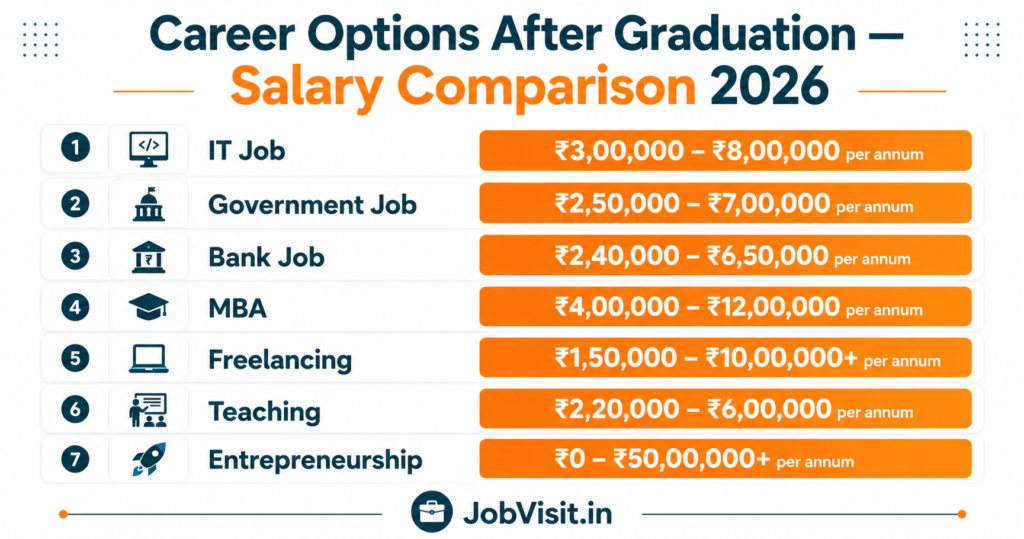
Salary Comparison — All Career Options at a Glance
| Career Path | Year 1 Salary | Year 5 Salary | Security |
|---|---|---|---|
| Private IT — Technical | ₹3.5 to ₹6 LPA | ₹8 to ₹18 LPA | Moderate |
| Private IT — Non Technical | ₹2.5 to ₹4 LPA | ₹5 to ₹10 LPA | Moderate |
| Government — SSC CGL | ₹4 to ₹5.5 LPA | ₹5.5 to ₹7 LPA | Very High |
| Banking — IBPS PO | ₹4.5 to ₹5.5 LPA | ₹6 to ₹9 LPA | Very High |
| MBA — Top College | ₹8 to ₹20 LPA | ₹15 to ₹40 LPA | High |
| Freelancing | ₹1 to ₹3 LPA | ₹5 to ₹18 LPA | Low |
| Teaching | ₹2 to ₹4 LPA | ₹3.5 to ₹7 LPA | High |
These are realistic ranges based on current Indian market conditions — not best-case scenarios pulled from placement brochures.
How to Choose the Right Path for You
Ask yourself three questions honestly.
What do I actually enjoy doing or find genuinely interesting — not what sounds impressive, but what I would willingly spend time on even without being told to.
What is my current financial situation — can I afford 6 to 12 months of exam preparation with no income, or do I need to start earning within the next 2 to 3 months.
What do I value more right now — stability and predictability, or growth potential and higher upside even with more uncertainty.
Your honest answers to these three questions will point clearly toward one or two paths from this list. Follow that direction specifically rather than spreading effort across multiple paths simultaneously — focused effort on one direction produces better results than scattered effort across five directions in the first two years after graduation.