Find a Job in India Without References or Connections in 2026
There is a conversation that happens in almost every Indian household after graduation.
Someone asks if you got a job yet. You say you are applying. They ask who you know at which company. You say nobody. They look at you with that expression — the one that suggests your job search is already at a disadvantage before it properly started.
In India, references and connections genuinely help. There is no point pretending otherwise. A referral from an existing employee moves your resume to the top of the pile faster than any qualification can. Knowing the right person at the right company can turn a six-month job search into a two-week one.
But here is what that conversation misses completely — millions of Indians get jobs every single year without knowing a single person in the company they join. The path is longer and requires more deliberate effort. It is absolutely not closed.
This guide covers exactly how to navigate a job search in India in 2026 when you are starting from zero connections.
Why the “No Connections” Problem Feels Bigger Than It Is
The connections advantage in Indian hiring is real but it is also concentrated in specific types of roles and companies.
Senior positions and specialized technical roles — yes, referrals matter enormously. Large established companies with formal HR processes — referrals help but structured applications work too. Entry-level freshers roles at most companies — the volume of hiring means HR teams cannot rely solely on referrals. They need to find candidates through job portals, campus drives, and direct applications.
This is the gap that freshers without connections can work through. Entry-level hiring in India is largely meritocratic at the screening stage — your resume and skills determine whether you get shortlisted, not who you know.
What Actually Replaces Connections in a Job Search
Connections do one primary thing — they get your resume seen by a decision-maker instead of sitting in a pile of hundreds. When you have no connections, you need to find other ways to make your resume visible and credible.
A strong Naukri or LinkedIn profile that appears in recruiter searches. A direct cold email to a hiring manager that gets read because it is well-written and specific. A walk-in drive where your physical presence makes you real to an interviewer. A portfolio of work that demonstrates skill more convincingly than any reference letter.
These are not inferior substitutes for connections. They are different paths to the same destination — getting in front of the right person.
7 Practical Ways to Find a Job in India Without References
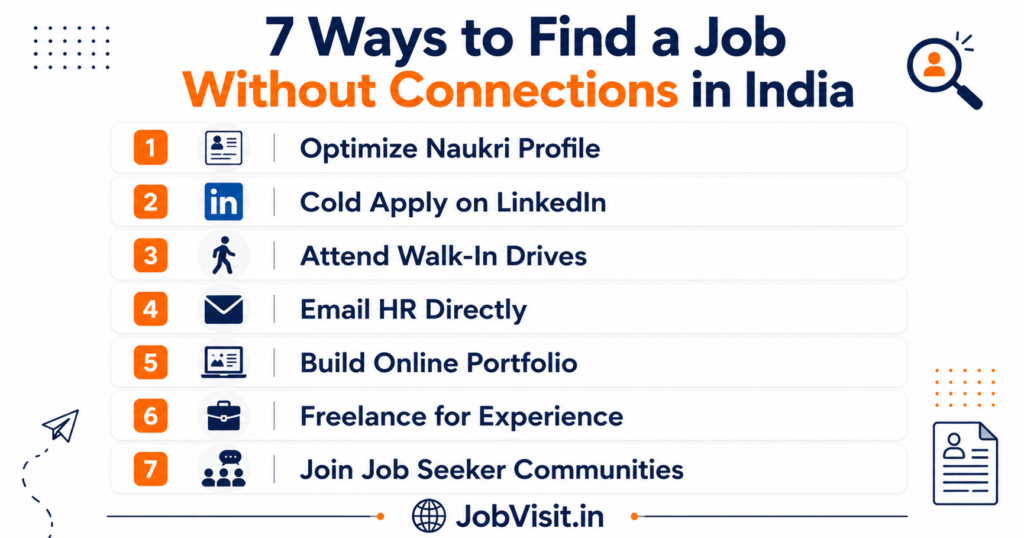
1. Build a Complete and Optimized Naukri Profile
Naukri.com is still the most widely used job platform by Indian HR teams and recruiters. A complete, well-optimized Naukri profile means recruiters actively searching for candidates with your background can find you without you doing anything.
What a Strong Naukri Profile Needs
Fill every single section completely — personal details, education, skills, projects, certifications, preferred job locations. The Naukri algorithm ranks profiles higher in recruiter searches when more sections are filled. An incomplete profile simply does not appear in searches as frequently as a complete one.
Upload a properly formatted resume as a PDF. Add a professional profile photo. Write a clear resume headline that mentions your target role specifically — not just “fresher” but “Data Entry Executive Fresher” or “IT Support Fresher” depending on what you are targeting.
How Often to Update Your Naukri Profile
Update your profile at least once every 7 days even if nothing changed. Go into the profile, make a small edit anywhere, and save. This signals to Naukri’s system that you are an active job seeker and bumps your profile higher in recruiter search results. Profiles that show recent activity appear before profiles that were last updated months ago.
2. Cold Apply on LinkedIn With Personalized Messages
LinkedIn has a feature called Easy Apply that allows you to apply for jobs directly on the platform. Many freshers use it by clicking Apply and submitting with their default profile — which is the same thing hundreds of other candidates are doing.

The way to stand out when cold applying without references is to send a direct message to the HR person or hiring manager posting the job — separately from the application itself.
How to Write a Cold Message That Gets Read
Keep it short. Three lines maximum. Mention the specific role. Mention one specific relevant skill or experience. Ask politely for consideration.
Example:
“Hi, I noticed you posted the Junior Data Entry Executive opening at your company. I recently completed my graduation with hands-on experience in document digitization and MS Excel data management. I have applied through LinkedIn and would genuinely appreciate your consideration. Thank you for your time.”
That message is specific, respectful, and brief. It does not beg. It does not list ten qualifications. It gets to the point and makes a clear ask. This approach — applying formally and then sending a short personal message — increases response rates noticeably compared to applications submitted without any personal outreach.
3. Attend Walk-In Drives Consistently
Walk-in drives are one of the most underused job search tools by freshers who live outside major metros — and one of the most effective ones for getting interviews without any connections whatsoever.
Walk-in drives are open to any qualifying candidate who shows up. No application, no referral, no recruiter relationship needed. You bring your documents and resume, you walk in, you meet a real person from the company.
How to Find Walk-In Drives in Your City
Check Naukri.com walk-in section daily — filter by your city and fresher experience level. Check local job Facebook groups — cities like Hyderabad, Vijayawada, and Bangalore have active groups where walk-in announcements are posted regularly. Follow local staffing agencies on WhatsApp and Telegram — they announce walk-ins before they are publicly listed anywhere.
What to Do at a Walk-In Drive That Most Freshers Do Not
Arrive early — the first 30 minutes of any walk-in drive sees less competition than the middle of the day. Dress properly — walk-in drives are real interviews regardless of how informal the announcement sounds. Bring five copies of your resume — not one, five. Carry original documents and photocopies of everything. After meeting any interviewer, ask specifically what the next step is and when you should follow up.
4. Email HR Directly — Cold Outreach to Companies
This approach requires more effort than most freshers are willing to invest — which is exactly why it works better than most freshers expect.
Pick 10 to 15 companies in your target city that hire for your target role. Find the HR email address or the name of the HR manager from LinkedIn. Send a short, professional email with your resume attached introducing yourself and expressing specific interest in opportunities at their company.
The Cold HR Email Format That Works
Subject line: Fresher Application — Data Entry Executive — Your Name
Body: Three short paragraphs. First paragraph — who you are and what you studied. Second paragraph — one specific relevant skill or experience and why it is relevant to their company. Third paragraph — a polite request for consideration and a statement that your resume is attached.
Do not write a long email. HR professionals receive hundreds of emails. A short, clear, professional email with a relevant subject line gets read. A long email gets closed.
How Many Companies to Approach This Way
Send cold emails to 10 companies per week. Not 10 in a month — 10 per week. Most will not respond. Some will. The ones that do respond to a cold email are already interested, which means the conversion from email to interview is significantly higher than the rate from job portal applications.
5. Build a Small Online Portfolio
A portfolio is the closest thing to a reference that you can create entirely for yourself.

For most fresher roles in India, a portfolio does not need to be elaborate. A simple Google Sites page or a PDF document that shows your academic projects, any freelance work you have done, certifications you have completed, and sample work relevant to your target role — this is enough to serve as credible evidence of your capability.
Why a Portfolio Replaces References Effectively
A reference from a known person says “I trust this candidate.” A portfolio says “here is actual evidence of what this candidate can do.” For entry-level roles, demonstrated work is often more convincing than a vouched recommendation from someone the recruiter does not know personally.
When applying to any role — include a link to your portfolio in your resume and in any cold messages you send. A link to real work turns a faceless application into a candidate who has already proved something.
6. Use Internshala for Internship-to-Job Conversion
Many freshers overlook internships because they want a full-time job immediately. This is an understandable preference and a strategically short-sighted one.
An internship at a company — even an unpaid or low-paid one — puts you inside the building. You build real experience, real references, and real relationships with people who can refer you for a full-time role either at the same company or at another company through their network.
How Internshala Works for Freshers Without Connections
Internshala posts thousands of internship opportunities from Indian companies across every sector. The application process is straightforward and competition for many roles is lower than full-time job applications because many freshers are not targeting internships seriously.
Apply for internships at companies where you genuinely want to work full-time. Treat every internship application and interview with the same seriousness as a full-time job application. Convert the internship into a reference and a portfolio piece regardless of whether it leads to a full-time offer at the same company.
7. Join Job Seeker Communities and Stay Active
There are active communities of Indian freshers and working professionals on Telegram, WhatsApp, LinkedIn, and Facebook where job leads, walk-in announcements, referral requests, and hiring information are shared daily.
These communities do not replace connections — they create new ones. A fresher who is active in a relevant professional community, contributes useful information occasionally, and reaches out respectfully to working professionals in their target field — is actively building the network they currently feel they lack.
Communities Worth Joining Right Now
Search Telegram for your target city plus jobs — “Hyderabad jobs fresher,” “IT jobs freshers India,” “work from home India 2026.” Join LinkedIn groups related to your target industry. Follow HR professionals at companies you want to work at and engage thoughtfully with their posts — not generic comments, but specific observations that demonstrate genuine interest in the topic they posted about.
The Mindset That Makes the Difference
Freshers without connections often approach job searching as a passive activity — send applications and wait for responses.
Freshers who find jobs without connections treat it as an active, daily effort — updating profiles, sending cold emails, attending walk-ins, building portfolio, engaging on LinkedIn, joining communities.
The difference is not intelligence or qualification. It is the decision to do more than the minimum every single day until something works.
In India’s entry-level job market in 2026, consistency and deliberate effort genuinely compensate for the absence of connections more than most freshers believe before they try it properly.