Most Common HR Interview Questions and Answers for Freshers in India 2026
Most freshers walk into HR interviews thinking the hard part is already done.
You got shortlisted. You researched the company a little. You ironed your clothes. You arrived on time. Surely that is enough to get through an HR round that everyone says is just a formality.
Then the interviewer asks “tell me about yourself” and you spend ninety seconds rambling through your entire educational history in reverse chronological order while the interviewer’s expression tells you everything you need to know about how it is going.
HR interviews in India are not formalities. They are structured evaluations of how you think, how you communicate, and whether you are the kind of person a company wants on their team. The questions are predictable — almost every HR interview uses variations of the same ten questions. The candidates who prepare specific, honest, well-structured answers to these questions consistently outperform candidates who rely on spontaneous answers regardless of how intelligent or qualified they are.
This guide covers all ten questions with exactly what to say and what not to say for each one.
Why HR Interview Preparation Matters More Than Most Freshers Think
Technical rounds test what you know. HR rounds test who you are and how you communicate.
A candidate who performs brilliantly in a technical assessment but stumbles through HR questions — gives vague answers, cannot explain their own resume clearly, gets flustered by basic questions about salary expectations — creates doubt in the interviewer’s mind about how they will perform in client interactions, team communication, and everyday professional situations.
HR interviewers in Indian companies are specifically trained to evaluate communication clarity, self-awareness, attitude toward work, and cultural fit. Every answer you give is being evaluated not just for content but for how confidently and clearly you deliver it.
The One Thing That Separates Good HR Answers From Bad Ones
Specificity and honesty.
Interviewers have heard thousands of generic answers. “I am a hard worker.” “My weakness is that I work too hard.” “I see myself in a leadership role in five years.” These answers communicate nothing real and experienced interviewers recognize them immediately as prepared generic responses with no actual thought behind them.
Specific, honest answers — even ones that are not perfect — are more impressive than polished generic ones. An interviewer would rather hear “my weakness is that I get anxious before presentations but I have been practicing by volunteering to speak in group settings” than “I am a perfectionist.”
10 Most Common HR Interview Questions and Answers for Freshers in India
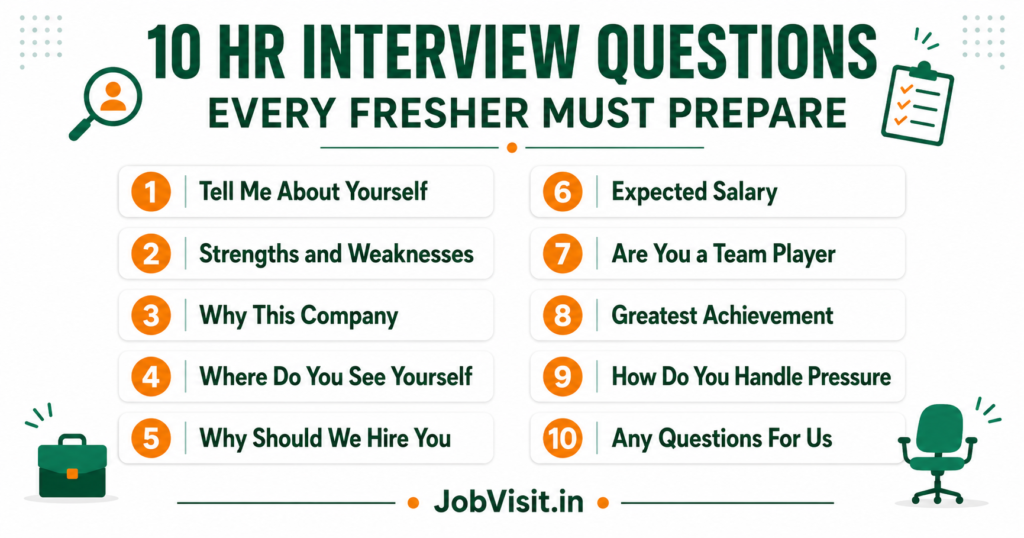
Question 1 — Tell Me About Yourself
This is the opening question in almost every Indian HR interview. It feels simple. It is not.
Most freshers answer this by reciting their resume — “I completed my graduation from XYZ college in 2025 with 72 percent. Before that I completed my 12th from ABC school.” The interviewer already has your resume. Reading it back to them wastes the best opportunity you have to make a strong first impression.
What Your Answer Should Actually Cover
Your answer to this question should cover four things in under 90 seconds. Who you are academically — one sentence. One real experience or skill that is relevant to this role — two sentences. What you are looking for in this role specifically — one sentence. One thing that makes you worth interviewing further — one sentence.
Sample Answer for a Fresher
“I completed my graduation in 2025 with a focus on computer applications and data management. During my final year I worked on a document digitization project that gave me practical experience handling large volumes of data accurately using MS Excel and document management tools. I am looking for an entry-level role where I can apply these skills in a professional environment and grow steadily. I am particularly interested in this role because your company works in IT services which is exactly the sector I want to build my career in.”
That answer is specific, relevant, confident, and under 90 seconds. Practice it until it sounds natural — not memorized.
Question 2 — What Are Your Strengths and Weaknesses
The strengths part is where most freshers either undersell themselves or sound arrogant. The weaknesses part is where most freshers either lie obviously or say something so generic it means nothing.
How to Answer Strengths
Pick two genuine strengths that are directly relevant to the role you are applying for. Do not list five. Do not say “I am very hard working” — everyone says this. Say something specific and back it up with a brief example.
“One of my genuine strengths is attention to detail. When I was digitizing court documents I caught several data entry errors that would have caused records mismatches later. The second strength I would mention is that I learn new tools quickly — I picked up a new document management software in two days when the previous system changed.”
How to Answer Weaknesses Honestly Without Damaging Yourself
Pick one real weakness that is not directly critical to the role and explain what you are doing to improve it.
“I used to get anxious when speaking in front of groups which affected how clearly I communicated in presentations. I started volunteering to present in college group projects specifically to get more comfortable with it and it has improved significantly though I am still working on it.”
That answer is honest, self-aware, and ends on a positive note. An interviewer hearing this thinks — this person knows themselves and takes improvement seriously. That is a genuinely good impression.
Question 3 — Why Do You Want to Work at This Company
This question separates candidates who did five minutes of research from candidates who thought about the role seriously.
Answering “because it is a reputed company” or “because it offers good growth opportunities” tells the interviewer you had no specific reason to apply here beyond it being a job opening. Every company is reputed to someone. Every company claims growth opportunities.
What a Good Answer to This Question Looks Like
Research the company before the interview — what they do, how large they are, what sector they are in, any recent news about them. Then answer with something specific.
“I researched your company before coming in and I noticed that you work primarily with government digitization projects which is directly relevant to the experience I have in document management. The scale of the work you do — handling official records for multiple organizations — is something I find genuinely interesting and I believe the experience I would get here is more aligned with where I want to grow than most other options I am considering.”
That answer shows research, genuine interest, and a specific connection between your background and their work. It takes ten minutes of preparation to make this possible.
Question 4 — Where Do You See Yourself in 5 Years
The instinct for many freshers is to say “in a leadership role” or “managing a team” because it sounds ambitious. The problem is that this answer in a fresher interview sounds disconnected from reality.
You are applying for an entry-level role. An answer about managing teams in five years without any discussion of how you will get there sounds like a rehearsed line rather than genuine thinking.
A Better Approach to This Question
Talk about skills you want to develop, the kind of professional you want to become, and how this role fits into that trajectory.
“In five years I see myself having developed strong expertise in data operations and analysis — having moved from entry-level work to handling more complex data projects independently. I want to be someone who companies rely on for accurate, well-organized data management rather than just someone who processes information. This role feels like the right place to start building toward that.”
That answer is realistic, specific, and shows that you have thought about your career development seriously rather than just giving an answer you think sounds good.
Question 5 — Why Should We Hire You
This is the question most freshers find hardest to answer without sounding either arrogant or desperate.
The honest answer is that you should be hired because you have specific relevant skills, you will work hard to deliver, and you are at a stage of your career where you are hungry to prove yourself. Say exactly that — with your specific skills filled in.
Sample Answer
“I think you should consider hiring me because I bring specific practical skills that are directly relevant to this role — particularly in data management and MS Office — that I can apply from day one without extensive training. I am at a stage of my career where getting this role right matters enormously to me which means my motivation level will be high consistently. And I am genuinely interested in this kind of work which in my experience makes a real difference to the quality of output over time.”
Honest. Specific. Confident without being arrogant.
Question 6 — What Is Your Expected Salary
This question makes most freshers either undersell themselves significantly or name a number that ends the conversation.
The right approach is to research the typical fresher salary for your target role in your city before the interview and give a reasonable range rather than a single number.
How to Answer Expected Salary as a Fresher
“I have researched typical starting salaries for this kind of role in Hyderabad and my understanding is that the range is generally between ₹2.5 LPA and ₹3.5 LPA for freshers. I am open to discussing within that range based on the full compensation package and the growth opportunities the role offers.”
That answer shows you did research, gives a reasonable range, and signals flexibility without desperation. Never say “whatever you think is fair” — it sounds passive and unprepared.
Question 7 — Are You a Team Player or Do You Prefer Working Alone
There is no wrong answer to this question — both working styles have value. What interviewers are evaluating is your self-awareness about how you work best and your ability to adapt.
The Right Way to Answer This
“I work well both independently and in teams depending on what the task requires. For focused individual tasks like data entry or detailed analysis I am comfortable working independently for extended periods. For projects that involve multiple stakeholders or require input from different people I genuinely enjoy the collaboration — I find that different perspectives usually produce better outcomes than any one person working alone.”

That answer is balanced, honest, and shows situational awareness rather than just saying what you think the interviewer wants to hear.
Question 8 — Tell Me About Your Greatest Achievement
For freshers this question feels difficult because you have no professional achievements to reference. But achievement does not have to mean professional achievement.
Academic projects, college activities, personal challenges overcome, skills self-taught — all of these count as genuine achievements worth discussing in an interview context.
Sample Answer Using an Academic Achievement
“My greatest achievement so far was completing my final year project — a student result management system — largely independently when most of my team members were unavailable during a critical phase. I had to learn parts of the database management I was not fully comfortable with, problem-solve under time pressure, and deliver a working product by the deadline. I learned more about my ability to handle pressure and figure things out independently from that experience than from almost anything else in my college years.”
A specific story about a real challenge overcome is far more impressive than a vague claim about being dedicated or hardworking.
Question 9 — How Do You Handle Pressure and Tight Deadlines
Every job involves pressure sometimes. Interviewers ask this to understand whether you will manage or fall apart when things get difficult.
The best answer includes a brief specific example and explains your actual approach rather than just claiming you handle pressure well.
Sample Answer
“I handle pressure reasonably well when I have a clear plan. When I face a tight deadline my first instinct is to break the work into the smallest possible steps and prioritize ruthlessly — figure out what absolutely must be done first and what can wait. During my document digitization work there were days when the volume was much higher than expected and I learned to stay focused on the current task rather than thinking about the total workload which tends to be paralyzing. I will not claim I never feel the pressure — I do — but it has not stopped me from delivering on time so far.”
Honest, specific, and realistic. That answer builds trust.
Question 10 — Do You Have Any Questions for Us
Most freshers answer this with “no, I think everything is clear.” This is a missed opportunity that communicates lack of genuine interest.
Always have two or three questions prepared. They do not need to be brilliant. They need to show that you thought about the role seriously.
Good Questions to Ask at the End of an Interview
“What does a typical first week look like for someone joining this role?”
“What are the main qualities that the people who have done well in this role have in common?”
“What would success look like in this position after three to six months?”
These questions show genuine interest in the role, demonstrate that you are thinking about how to succeed rather than just how to get hired, and often produce useful information about what the company actually values.
The Most Important Interview Preparation Advice
Practice out loud.
Reading answers in your head feels like preparation. It is not. The gap between how an answer sounds in your head and how it comes out of your mouth when you are nervous in an interview is enormous.
Practice every answer in this guide out loud — ideally in front of a mirror or recording yourself on your phone. Listen back. Notice where you stumble, where you say “um” repeatedly, where your answer goes on too long. Fix those specific things and practice again.
Three hours of out-loud practice produces better interview performance than ten hours of reading preparation. This is consistently true and consistently ignored by freshers who feel awkward practicing alone.
Do the awkward thing. It works.