What to Wear to a Job Interview in India 2026 — Complete Dress Code Guide
Nobody tells you this clearly enough before your first interview.
You prepare your answers. You research the company. You print five copies of your resume. And then you stand in front of your wardrobe the night before and have absolutely no idea what to wear because nobody gave you a straight answer about what is actually appropriate.
What you wear to an interview in India matters more than most people admit and less than some people fear. It matters because appearance signals professionalism before you say a single word. It matters less than people fear because you do not need expensive clothes — you need appropriate, clean, well-fitted clothes.
This guide gives you the straight answer based on company type, role type, and practical reality for freshers in India in 2026.
Why Interview Appearance Matters in India Specifically
Indian corporate culture places significant value on presentation and first impressions. This is more pronounced in India than in many Western countries where casual interview attire has become more acceptable across industries.
An interviewer in India who sees a candidate arrive in clean formal clothing — even simple and budget-friendly formal clothing — receives an immediate signal that the candidate takes the opportunity seriously. An interviewer who sees a candidate arrive in casual clothing receives the opposite signal regardless of how well that candidate answers questions.
This is not about judging people by their clothes. It is about understanding the professional culture you are entering and presenting yourself appropriately within it.
The Difference Between Overdressed and Appropriately Dressed
There is almost no such thing as overdressed for a fresher interview in India. A fresher who shows up in smart formal attire for an interview at a casual startup looks enthusiastic and serious. A fresher who shows up casually dressed for an interview at a formal corporate office looks like they did not bother to prepare.
When in doubt — dress one level more formally than you think is necessary. It is always better to be the most formally dressed person in the room than the least.
Interview Dress Code by Company Type in India
IT Service Companies — TCS, Infosys, Wipro, HCL and Similar
These companies have formal professional cultures even at the entry level. Their offices are client-facing environments and they hire candidates who look like they understand professional settings.
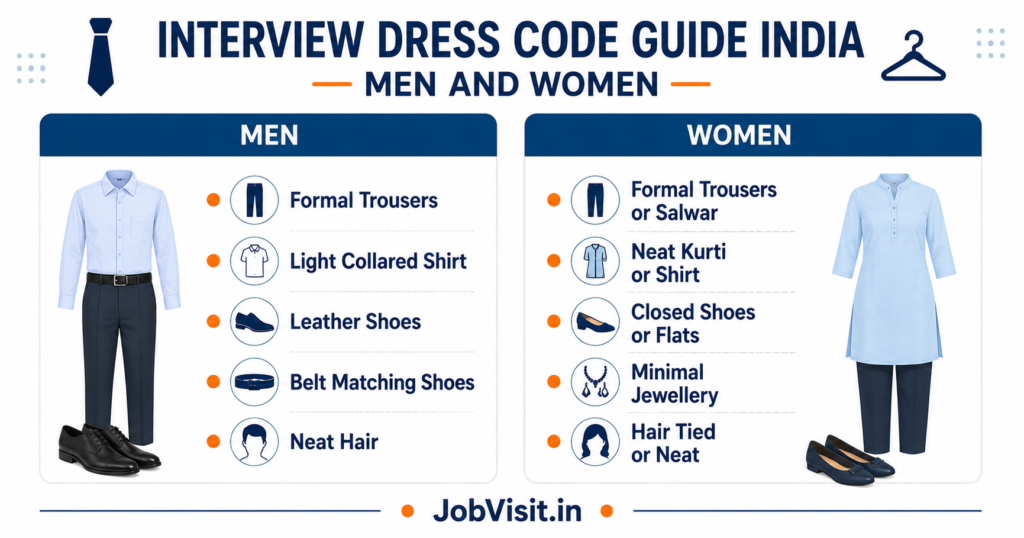
What Men Should Wear
Formal trousers in dark colors — navy, black, dark grey, or dark brown. A light colored full-sleeve collared shirt — white, light blue, light grey, or pastel shades. The shirt should be tucked in completely. A leather belt matching your shoe color. Leather shoes — black or dark brown, clean and polished. Socks that match your trousers or shoes — not white socks with dark shoes which is a surprisingly common mistake.
A formal blazer is optional but adds significantly to the impression you make. If you own one that fits well — wear it.
Hair should be neatly combed. If your hair is long, tie it back or style it neatly. Avoid strong perfumes — a light deodorant is enough.
What Women Should Wear
Formal trousers or a formal skirt with a neat shirt or blouse. A well-fitted salwar kameez in solid colors or subtle prints is entirely appropriate and common in Indian corporate environments — do not feel pressured to wear Western formal if Indian formal is what you are comfortable in.
Colors should be professional — avoid bright red, neon colors, or heavily patterned fabric for the main outfit. Neutral tones, pastels, and deep solid colors all work well.
Closed-toe shoes or clean flat shoes are appropriate. Minimal jewellery — small earrings, a simple watch if you have one. Hair should be tied back neatly or styled in a way that keeps it off your face. Light, natural-looking makeup is appropriate — heavy or dramatic makeup is not.
BPOs and Customer Support Companies
BPO companies in India — particularly those handling international clients — have slightly less rigid dress codes than traditional IT companies but professional appearance remains important.
Smart casual to formal is appropriate. Men can wear well-fitted dark jeans with a collared shirt tucked in and clean shoes — though formal trousers are always safe. Women can wear neat kurtas with leggings or formal trousers with a neat top.
Avoid anything that looks too casual — t-shirts, very light fabric that is see-through, sandals or slippers, heavily distressed clothing.
Startups and Product Companies
Indian startups — particularly in cities like Bangalore and Hyderabad — have genuinely more casual office cultures. Founders and employees often dress casually in the office daily. However this does not mean interview attire should be casual.
Even at startups, arriving in smart formal or smart casual attire for an interview signals that you take the opportunity seriously. After you join and observe the actual office culture you can adjust how you dress daily. For the interview — dress up.
Smart casual for startups means well-fitted dark chinos or formal trousers, a neat half-sleeve or full-sleeve collared shirt or polo for men. For women — neat fitted trousers or a midi skirt with a professional-looking top or neat kurti.
Banks and Financial Institutions
Banks in India have the most formal dress code expectations of any sector. If you are interviewing at IBPS, SBI, or any public or private sector bank — dress at your most formal.
Men should wear formal trousers, a light-colored full-sleeve shirt, a tie if they own one, and formal leather shoes. A blazer strongly recommended.
Women should wear a formal saree, salwar kameez in muted professional colors, or formal Western attire. Banks specifically appreciate traditional Indian professional attire for women — a neat cotton or synthetic saree in a professional color is entirely appropriate and often appreciated.
Government Organizations and PSUs
Similar to banks — formal, conservative, and traditional attire is most appropriate. Government interview panels in India tend to be traditional in their expectations and appearance judgments.
Men — formal trousers, full-sleeve collared shirt, formal shoes. Women — saree or neat salwar kameez. Both conservative in color and style.
Budget-Friendly Interview Outfit Ideas for Freshers in India
You do not need to spend a lot of money on interview clothes. Here is what actually matters — clean, well-fitted, and appropriate for the company type.
A formal trouser and shirt combination from any mid-range clothing store — even FBB, Pantaloons sale section, or Myntra budget options — looks professional when it fits well and is freshly ironed. An ill-fitting expensive outfit looks worse than a well-fitted affordable one.
Where to Buy Affordable Formal Interview Wear in India
FBB stores inside Big Bazaar locations carry affordable formal trousers and shirts starting from ₹299 to ₹599. Pantaloons during sales offers formal pieces at significant discounts. Myntra and Ajio have budget formal wear sections with reasonable quality at affordable prices. Local tailors in most Indian cities can alter purchased clothes for ₹50 to ₹150 to ensure proper fit — this investment is often more valuable than buying more expensive clothes that do not fit well.
Grooming Details That Matter as Much as Clothing
For Men
Facial hair should be neatly trimmed or cleanly shaved. Stubble that looks like you forgot to shave rather than deliberately styled stubble is a negative signal. Nails should be clean and trimmed. Hands matter more than most freshers realize — interviewers often shake hands and notice.
For Women
Nails should be clean and trimmed. If painted, use neutral or professional colors — not chipped bright nail polish which looks neglected. Hair should be neat and away from the face. If wearing a dupatta with a salwar — pin it or drape it so it stays in place and does not require constant adjustment during the interview.
The Night Before Interview Clothes Checklist
Do this the night before every interview — not the morning of:
- Outfit selected and laid out completely including shoes, belt, accessories
- Clothes ironed or steamed — no visible wrinkles
- Shoes wiped clean or polished
- Clothes smell fresh — hang them out if they have been stored
- Spare safety pins if wearing a saree or dupatta
- Light deodorant ready — not strong perfume
- Portfolio or folder to carry documents is neat and clean
Common Mistakes Freshers Make With Interview Attire in India
Wearing strong perfume or cologne. Interview rooms are often small. Strong fragrance in an enclosed space is distracting and sometimes uncomfortable for interviewers. A light deodorant is enough.
Wearing new shoes that have never been worn before. New shoes cause blisters and discomfort during long walk-in interview days. If you bought new shoes for the interview — wear them at home for a few hours first.
Forgetting about the weather. Summer interviews in Hyderabad or Chennai can be extremely hot. Wearing a heavy formal blazer without planning for the heat leads to visibly sweaty, uncomfortable interviews. Wear breathable formal fabrics in summers — cotton shirts and light trousers are both formal and practical.
Wearing casual footwear with formal clothes. Formal trousers with sports shoes or sandals undermines the entire formal impression immediately. Shoes matter as much as clothing in how put-together the overall impression is.
Checking the mirror only from the front. Turn around before leaving home. Check how the back of your outfit looks. Shirts that are only half-tucked at the back, tags sticking out, or clothing that fits poorly from the back are visible to everyone in the waiting area and as you walk into the interview room.
Final Thought on Interview Dress in India
Looking good for an interview is not about vanity. It is about communication.
Your appearance before you speak communicates whether you understand professional contexts, whether you prepared for this specifically, and whether you respect the interviewer’s time and the company’s culture enough to make an effort.
None of this requires expensive clothes. It requires clean clothes, appropriate clothes, and the five minutes of preparation the night before to make sure everything is ready.
That five minutes has a real return. Use it.