How to Answer What Is Your Expected Salary as a Fresher in India 2026
The salary question arrives in almost every Indian interview and almost every fresher handles it badly.
Some say a number that is too high and watch the interviewer’s expression shift. Some say a number that is far too low and immediately undervalue themselves for the rest of the hiring process. Some say “whatever you think is fair” which sounds passive and unprepared. And some panic completely and give an answer that makes no sense in the context of the role or their own qualifications.
None of these responses are necessary. The salary question has a correct approach — one that is confident, researched, and leaves room for negotiation without pricing you out of the opportunity or undervaluing you from the start.
This guide covers exactly how to handle it.
Why the Salary Question Is Actually an Opportunity
Most freshers experience the expected salary question as a threat — say the wrong number and lose the opportunity. That is the wrong frame entirely.
The salary question is an opportunity to demonstrate that you have done your research, that you understand your own value, and that you can discuss professional topics confidently and specifically. An interviewer who asks this question is not trying to trap you. They are trying to understand whether your expectations are aligned with what the role offers — and whether you are the kind of person who has done their homework.
What Interviewers Are Actually Evaluating
They are checking three things. Whether your expectation is realistic for the role and your experience level. Whether you can discuss numbers confidently without becoming flustered. Whether you understand the market well enough to have a basis for your answer.
A fresher who gives a confident, researched range with a brief explanation of how they arrived at it scores well on all three regardless of whether the specific number is exactly what the company planned to offer.
Research First — Know the Market Before You Walk In
The most important preparation for the salary question happens before the interview — not during it.
You need to know the typical fresher salary range for your specific target role in your specific city before you sit down across from any interviewer. Answering without this research means guessing — and guesses are almost always either too high or too low.
How to Research Fresher Salaries in India
Check Glassdoor and AmbitionBox — both platforms have salary data submitted by Indian employees including freshers. Search specifically for the role title plus “fresher” plus your city.
Check Naukri salary insights — Naukri has a salary research section that shows average compensation for roles by experience level and location.

Look at job postings themselves — many Indian job postings include salary ranges. Reading twenty postings for your target role gives you a clear picture of what companies in your city are currently offering freshers.
Talk to people who recently joined in similar roles — college seniors, LinkedIn connections, anyone in your network who took a similar role in the past year. Real experience is often more accurate than platform data.
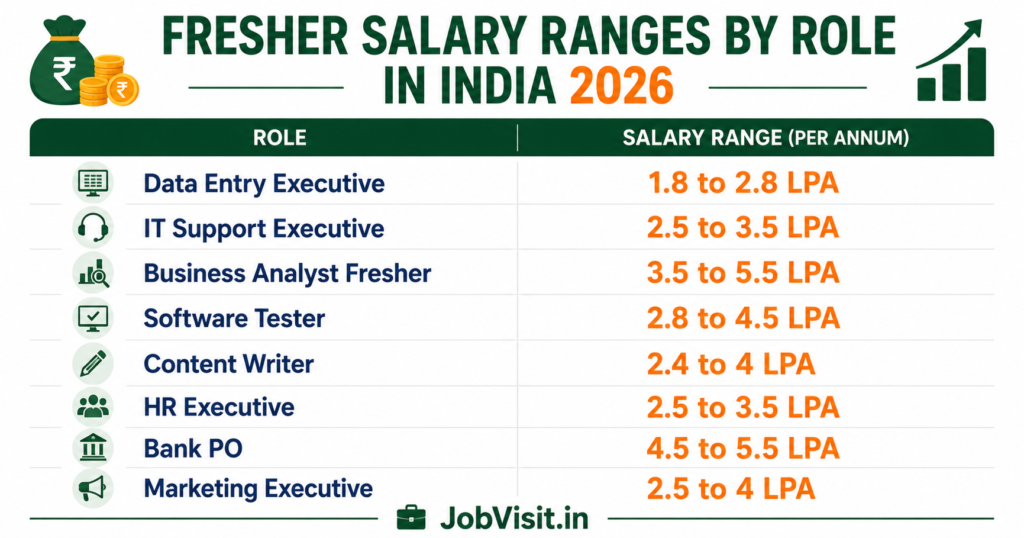
Fresher Salary Ranges by Role in India — 2026 Reference
Use these as your research starting point. Actual offers vary by company size, city, and specific role requirements.
| Role | Typical Fresher Range | Notes |
|---|---|---|
| Data Entry Executive | ₹1.8 to ₹2.8 LPA | Higher in metros |
| IT Support Executive | ₹2.5 to ₹3.5 LPA | BPO vs IT company varies |
| Business Analyst | ₹3.5 to ₹5.5 LPA | Depends heavily on company |
| Software Tester | ₹2.8 to ₹4.5 LPA | Product companies pay more |
| Content Writer | ₹2.4 to ₹4 LPA | Agency vs in-house varies |
| HR Executive | ₹2.5 to ₹3.5 LPA | Smaller companies lower |
| Bank PO | ₹4.5 to ₹5.5 LPA | Includes allowances |
| Marketing Executive | ₹2.5 to ₹4 LPA | Startup vs corporate varies |
How to Structure Your Salary Answer
The Formula That Works
State that you have researched the market. Give a specific range based on that research. Express flexibility based on the complete package. Keep it under four sentences total.
That is the complete formula. Here is what it sounds like in practice.
Sample Answers for Different Situations
Sample Answer 1 — When You Have Done Research
“Based on the research I have done on current fresher salaries for this role in Hyderabad, my understanding is that the typical range is between ₹2.5 LPA and ₹3.5 LPA. I would be comfortable with an offer in that range and I am open to discussing based on the complete compensation package including any allowances or benefits the role includes.”
That answer is confident, specific, researched, and flexible. It does not sound desperate and it does not sound unrealistic.
Sample Answer 2 — When You Are Genuinely Unsure of the Range
“I want to be honest that I am still learning about compensation norms for this specific role. From what I have researched, fresher ranges in this field seem to be around ₹2.5 to ₹3.5 LPA in this city but I would genuinely appreciate understanding what the company typically offers for this position so I can share whether that aligns with my expectations.”
This answer works when you are unsure because it is honest, shows you have done some research, and redirects the question back to the company in a way that sounds professional rather than evasive.
Sample Answer 3 — When the Interviewer Pushes for a Single Number
Sometimes interviewers push past the range and ask for a specific number. In this situation give the midpoint of your researched range.
“If you need a specific number I would say ₹3 LPA as my expectation, with openness to discuss based on the full package.”
Short, direct, specific. Do not negotiate against yourself by immediately offering lower when pushed.
What Never to Say When Asked About Expected Salary
Never Say — Whatever You Think Is Fair
This sounds humble but communicates that you have not thought about it and are passive about your own professional value. Interviewers do not find this impressive. They find it unprepared.
Never Say — I Just Need Any Job Right Now
Even if this is true — saying it removes your negotiating position entirely and signals desperation that makes companies question whether they are hiring someone reliable or just someone who cannot find work elsewhere.

Never Say a Number Without Any Basis
“I want ₹5 LPA” with no explanation when the role typically pays ₹2.5 LPA shows you have not researched the market. “I want ₹5 LPA based on my research of what senior professionals in this role earn” when you are applying as a fresher with zero experience shows you have not understood the difference between senior and fresher compensation.
Never Lie About a Competing Offer You Do Not Have
Some freshers claim they have a competing offer at a higher salary to gain negotiating leverage. If the interviewer asks for details — which experienced ones often do — this falls apart immediately and destroys your credibility for the rest of the process.
How to Negotiate Salary as a Fresher — Is It Appropriate
The answer is yes — within reason and in the right way.
If a company offers you something below the lower end of the range you researched, it is completely professional to say so calmly and ask if there is flexibility.
How to Negotiate Without Damaging the Offer
“Thank you for the offer. I had researched the typical range for this role at around ₹X to ₹Y and the offer is slightly below that. Is there any flexibility in the compensation given that I bring specific skills in these areas that are directly relevant to the role?”
That negotiation request is specific, polite, and backed by research rather than just wanting more money. Companies expect negotiation at this level and do not withdraw offers because a candidate asked professionally.
What does damage offers — demanding significantly above market rate, negotiating multiple times on the same point after a final offer is stated, or making salary the only thing you discuss rather than demonstrating genuine interest in the role itself.
After the Interview — Evaluating the Offer You Receive
When an offer comes — evaluate the total compensation rather than just the base salary.
Some companies offer lower base but provide transport allowance, food allowance, performance bonuses, or health insurance that meaningfully increases the total value. A job offering ₹2.8 LPA base with transport and food allowances totaling ₹8,000 per month is effectively worth ₹3.76 LPA in real take-home value.
Ask specifically — what allowances are included, is there a performance review after six months, what is the typical increment at the first annual review. These questions show financial maturity and give you information that changes whether the offer is actually as low as the base salary suggests.
The Mindset That Makes Salary Discussions Easier
The salary discussion feels uncomfortable for most freshers because it feels like asking for something. Reframe it.
You are not asking for money. You are discussing fair exchange — your skills and time in exchange for appropriate compensation. You have done research. You know the market. You know what your skills are worth at entry level. You are discussing whether this company’s offer aligns with that — professionally and calmly.
That mindset produces confident, clear salary discussions that leave interviewers with a positive impression rather than the awkward fumbling that happens when freshers treat the question as something to survive rather than handle.