Body Language Tips for Job Interviews in India 2026 — What Recruiters Notice mostly?
You can prepare perfect answers to every interview question and still lose the opportunity because of how you sat in the chair.
This sounds dramatic. It is not. Research on hiring decisions consistently shows that interviewers form strong initial impressions within the first 30 to 90 seconds of meeting a candidate — before any substantive answer has been given. Those impressions are formed almost entirely from non-verbal signals — how you walk in, how you shake hands, how you sit, where you look, and what your posture communicates about your confidence level.
In India specifically, where formal professional culture places significant weight on respect and composure, body language signals are evaluated carefully — often without the interviewer consciously realizing they are doing it. They just know whether they felt comfortable with you or not. And that feeling is largely determined by your body language.
This guide covers what interviewers in India actually notice and exactly what to do about each one.
Why Body Language Matters More in Indian Interviews Than Most Freshers Realize
Indian corporate culture is relationship-oriented. Hiring decisions are not purely analytical evaluations of skill and qualification — they involve a genuine assessment of whether this person will fit into the team, communicate well with colleagues and clients, and represent the company appropriately.
Body language is the primary channel through which these judgments are made in the first few minutes of any interaction. A candidate who walks in confidently, greets warmly, sits attentively, and engages actively with the interviewer communicates trustworthiness and professionalism before answering a single question.
A candidate who shuffles in nervously, avoids eye contact, slouches in the chair, and constantly fidgets communicates anxiety and lack of confidence — again, before saying anything at all.
What Interviewers Notice But Rarely Mention
Most interviewers in India will not tell you your body language was a problem. They will just not call you back. The feedback you receive — if any — will mention something vague about “cultural fit” or “confidence level.” Understanding what specifically created that impression is the only way to fix it.
The Gap Between How You Feel and How You Look
Nervous people almost always underestimate how visibly nervous they appear. You feel slightly anxious inside. To the interviewer across the table you look significantly anxious because they are watching your external signals — the bouncing leg, the hands constantly moving, the eyes that never quite settle — rather than knowing what you are feeling internally.
The good news is that body language is entirely trainable. Unlike interview answers that require knowledge and preparation, body language improves with deliberate awareness and a small amount of practice.
Body Language Tips for Job Interviews in India — What to Do and What to Avoid
1. How You Enter the Room
The interview begins the moment you step through the door — not when the first question is asked.
Walk in at a normal pace. Not rushing. Not shuffling. Head up, shoulders back, at a pace that communicates you belong in that room. If there are multiple people in the room, make brief eye contact with each person as you enter.
The Most Common Mistake When Entering
Looking at the floor or at your documents while walking in. This happens automatically when people are nervous and it communicates exactly the opposite of what you want to communicate. Before you open the door — take one breath, bring your chin up to parallel with the floor, and walk in looking at the people in the room.
2. The Handshake
In Indian corporate interviews, a handshake is offered by the interviewer in most formal settings. When offered — respond with a firm, brief handshake.
Firm means your grip has actual pressure — not bone-crushing, but not limp either. A limp handshake is one of the most consistently noted negative signals in Indian hiring contexts. It communicates lack of confidence immediately and creates a negative first impression that takes the rest of the interview to overcome.
Brief means two to three seconds and one or two pumps — not holding on too long which becomes uncomfortable.
If No Handshake Is Offered
Some interviewers in India — particularly women interviewers or in more traditional contexts — may not offer a handshake. Do not reach out first in these situations. A respectful nod and a clear “good morning” or “good afternoon” is the appropriate greeting.
3. How You Sit
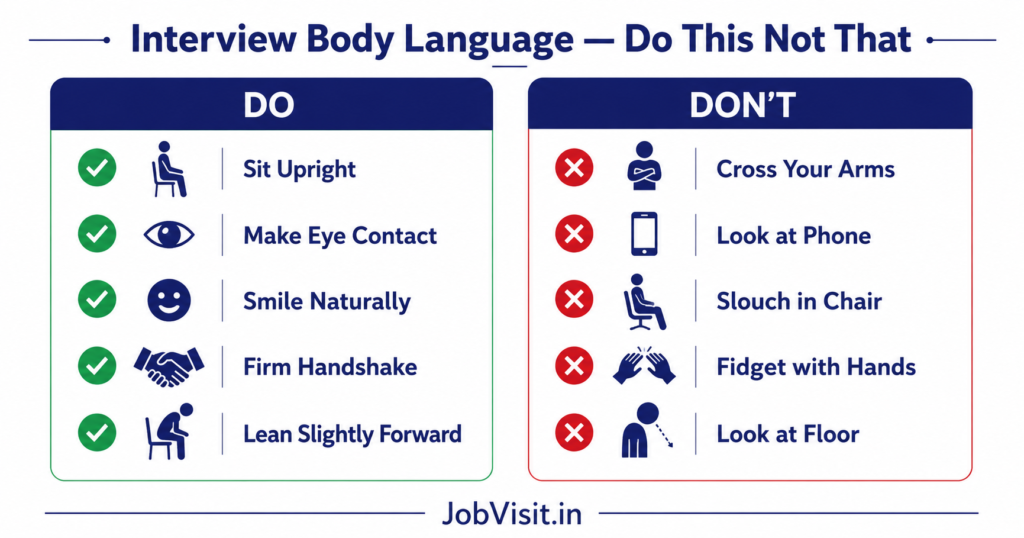
Sit up straight with your back against or close to the back of the chair. Both feet flat on the floor. Hands resting in your lap or lightly on the table if there is one in front of you.
This position communicates attentiveness and confidence. It also physically helps you breathe more easily and speak more clearly — which directly improves the quality of your verbal answers.
What to Avoid When Sitting
Crossing your arms across your chest. This is one of the most analyzed body language signals in hiring contexts — it communicates defensiveness or discomfort regardless of your actual intention. Keep your arms open and relaxed.

Slouching backward in the chair. This communicates disinterest or excessive casualness — neither of which serves you in a formal Indian interview setting.
Crossing your legs and bouncing the crossed foot. The repetitive motion is distracting and communicates nervous energy. Feet flat on the floor is both the professional standard and the physically most stable position.
Leaning too far forward aggressively. A slight forward lean — maybe 10 to 15 degrees — communicates engaged interest. Leaning across the table into someone’s personal space communicates aggression or desperation.
4. Eye Contact
Eye contact in Indian professional settings is nuanced. Too little communicates lack of confidence or dishonesty. Too much becomes a stare that creates discomfort.
The right balance is sustained but natural eye contact — looking at the interviewer’s face while they are speaking and while you are answering, occasionally breaking briefly and returning. Think of it as the eye contact you would use in a serious conversation with someone you respect — present and engaged but not unblinking.
In Panel Interviews With Multiple Interviewers
This is where many freshers struggle. When a question is asked by one interviewer, begin your answer looking at them, then distribute your eye contact across the panel as you continue — returning to the person who asked the question as you finish your answer.
Answering entirely to one person in a panel interview while ignoring others makes the ignored panel members feel excluded and is a consistently noted negative in panel interview feedback.
5. What to Do With Your Hands
Hands are where nervous energy shows most visibly. Constantly touching your face, playing with a pen, wringing your hands, or drumming fingers on the table — all of these communicate anxiety clearly to an experienced interviewer.
The simple solution is to give your hands a default position and keep them there when you are not gesturing to make a point.
Default position — hands resting in your lap or lightly clasped together on the table in front of you if there is one. Relaxed. Still. This is your neutral position that you return to between gestures.
Using Hand Gestures When Speaking
Natural hand gestures while speaking are positive — they communicate enthusiasm and help emphasize points. The key word is natural. Forced or exaggerated gestures look rehearsed and can be distracting.
Let your hands move when they want to move to emphasize something genuine. Actively suppress the nervous movements — touching face, playing with objects, repetitive tapping. The difference between expressive and nervous gesturing is whether the movement adds meaning or just releases tension.
6. Your Facial Expression
The default expression on your face between speaking and listening matters more than most people realize.
A neutral face that tilts slightly toward attentive and engaged — small natural smile, focused eyes — communicates that you are present and interested. A neutral face that tilts toward flat or tense — no expression, tight jaw, furrowed brow — communicates either discomfort or disinterest.
You do not need to smile constantly. Constant smiling in a professional Indian interview context actually looks nervous rather than friendly. But a relaxed, mildly positive default expression throughout the interview makes a significant difference to how likeable and approachable you come across.
Nodding While the Interviewer Speaks
Nodding occasionally while an interviewer is speaking communicates that you are actively listening and following what they are saying. Small, natural nods — not exaggerated head movements. This simple signal is noticed positively and contributes to the overall impression of attentiveness.
7. Your Voice — Pace and Volume
This sits at the intersection of verbal and non-verbal communication but it belongs in a body language discussion because it is often driven by physical tension rather than preparation.
Nervous freshers speak too fast. The anxiety creates urgency that comes out as rushing through answers. Fast speech is harder to follow, communicates anxiety, and reduces the apparent confidence of even well-prepared answers.
Deliberately slow down by about 20 percent from whatever pace feels natural when you are nervous. It will feel unnaturally slow to you. To the interviewer it will sound measured and confident.
Volume in Indian Interview Rooms
Speak loudly enough to be heard clearly across a normal interview table without the interviewer leaning forward. This sounds obvious but freshers who are nervous frequently speak at a volume that requires the interviewer to strain to hear — which is tiring and creates subconscious frustration.
If you are naturally soft-spoken, consciously project your voice slightly more than feels natural. Proper posture — sitting upright rather than slouching — physically helps with this because it opens the chest and diaphragm.
8. How You Behave While Waiting
Many candidates lose the interview before it starts — in the waiting area.
Sitting with perfect posture in the waiting area, not looking at your phone constantly, greeting reception staff or other employees with a polite acknowledgment — all of this can be noticed and mentioned to the interviewer. Companies with strong hiring cultures specifically ask reception staff whether waiting candidates seemed professional and respectful.
This is not paranoia — it is a real practice in many Indian companies that take culture fit seriously. Treat the entire time from when you enter the building to when you leave it as part of the evaluation.
9. How You Leave the Room
The exit is the last impression you leave and it is remembered clearly because it is the most recent.
Stand up fully before speaking your exit. Thank the interviewer clearly by name if you know it — “Thank you very much for your time, I genuinely enjoyed this conversation.” If a handshake is offered, give the same firm brief handshake as the entrance. Walk out at the same calm, confident pace you walked in.
Do not rush out as if relieved it is over. Do not linger awkwardly. Stand, thank, shake if offered, exit calmly.
The One Sentence That Leaves the Best Final Impression
Before leaving — “I am very interested in this role and I look forward to hearing about the next steps.”
That sentence communicates genuine interest, confidence, and forward momentum. It takes three seconds to say and it is the last thing the interviewer hears from you as you leave the room.
Practicing Body Language Before Your Interview
Reading about body language and actually doing it in a stressful interview situation are different things. The gap between knowing and doing closes only with practice.
Stand in front of a mirror and practice sitting down, making eye contact with your own reflection, speaking at a measured pace, and keeping your hands still. Do this for fifteen minutes before any interview.
Better still — record yourself on your phone answering two or three common interview questions. Watch it back specifically looking for body language signals — your posture, what your hands are doing, whether you are maintaining eye contact with the camera, whether your pace is measured or rushed.
Most people find this uncomfortable. That discomfort is useful because it shows you exactly what the interviewer sees rather than what you imagine they see.
The Single Most Important Body Language Principle
Be present.
Every specific tip in this guide — eye contact, posture, hand position, pace — flows naturally from one underlying state. When you are genuinely present in the conversation — listening carefully, thinking about what is being said, responding specifically to what was asked rather than delivering a memorized speech — your body language automatically improves.
The interviewer feels heard. Your eye contact is natural because you are actually looking at them. Your hands are still because you are focused on the conversation rather than your own anxiety. Your posture is upright because you are engaged rather than retreating.
Practice the specific tips. But pursue the underlying state — genuine presence and engagement — because that is what produces the overall impression that gets you hired.