How to Follow Up After a Job Interview in India 2026 — With Email Templates You should know!
The interview is done. You walked out feeling reasonably good about it. And now you wait.
A day passes. Then three days. Then a week. You start wondering whether you should send a message or whether that would seem desperate. You think about calling but are not sure if that is appropriate. You check your email twenty times a day hoping for something that does not arrive.
This waiting period after an interview is one of the most uncomfortable parts of the job search for freshers in India — and most people handle it by doing nothing and hoping. That passivity is a missed opportunity.
Following up after an interview is not desperate. It is professional. It communicates genuine interest, demonstrates initiative, and keeps your name in the interviewer’s mind during a decision-making period when dozens of candidates are being evaluated simultaneously.
This guide covers exactly when to follow up, how to follow up, what to write, and what to do when there is still no response.
Why Following Up After an Interview in India Actually Matters
Consider the interviewer’s situation. They met five, ten, sometimes twenty candidates in a single day during a hiring drive. Each conversation blends into the others. A candidate who was genuinely impressive in the interview but did nothing afterward becomes a fading memory within 48 hours.
A candidate who sends a brief, professional, specific follow-up email within 24 hours of the interview stays present. Their name appears in the interviewer’s inbox at a moment when the hiring decision is still being made. The email — if well written — reinforces the positive impression from the interview with a written demonstration of professionalism and communication ability.
This small action separates candidates in a pool where most people do nothing and wait passively.
Is Following Up Appropriate in Indian Professional Culture
Yes — when done professionally and with appropriate timing. Indian corporate culture values initiative and respect simultaneously. A follow-up that is too aggressive or too soon crosses into inappropriate. A follow-up that is polite, specific, and timed correctly is received positively by most Indian hiring managers.
The key distinction is between following up to express genuine interest and following up to pressure someone into a decision. The first is professional. The second is not.
When to Follow Up After a Job Interview in India
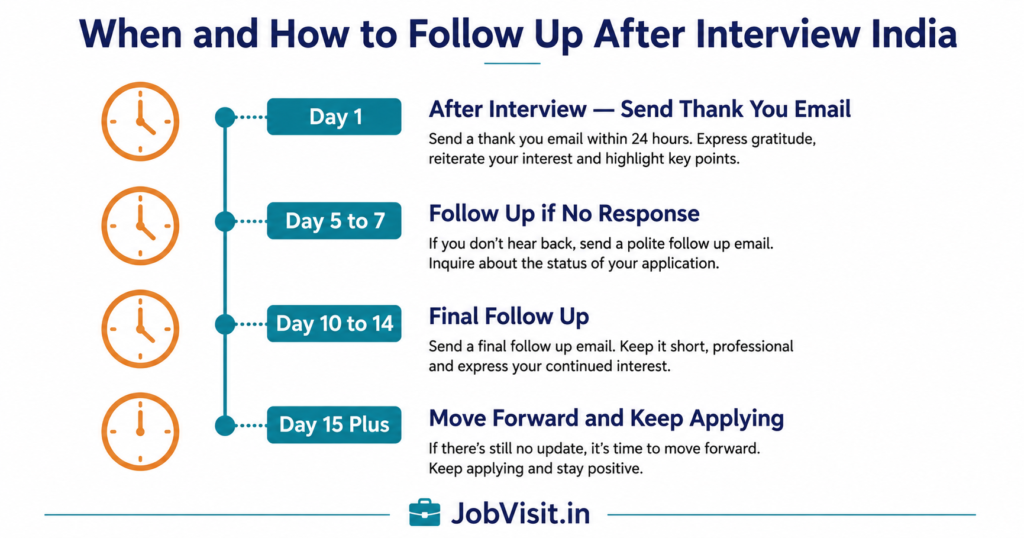
Timing matters significantly. Too soon looks desperate. Too late loses relevance.
The Thank You Email — Within 24 Hours
Send a brief thank you email within 24 hours of the interview. This is the most important follow-up action and the one most freshers skip entirely.
This email serves two purposes. It demonstrates professionalism and attention to detail — qualities that are evaluated through every interaction including post-interview communication. And it gives you one more touchpoint with the interviewer during the period when they are comparing candidates.
The First Follow-Up — Day 5 to 7 After Interview
If the interviewer told you to expect a response within a certain time and that time has passed — or if no timeline was given and a week has passed — a polite follow-up email is appropriate.

The Second Follow-Up — Day 10 to 14
If your first follow-up received no response, one more follow-up after another five to seven days is reasonable. After this point, continuing to follow up crosses from professional persistence into pushiness that can damage your impression with the company.
Moving Forward — After Day 15
If two follow-ups have received no response after two weeks — continue your job search actively rather than waiting on this single opportunity. You can keep the company on your radar for future openings but do not put your entire job search on hold waiting for a response that may not come.
Email Templates for Every Follow-Up Situation
Template 1 — Thank You Email Within 24 Hours
Subject line:
Thank You — [Role Name] Interview — [Your Full Name]Email body:
Dear [Interviewer Name],

Thank you for taking the time to speak with me today about the [Role Name] position at [Company Name].

I genuinely enjoyed learning more about the role and the work your team does, particularly [mention one specific thing discussed in the interview — a project, a challenge the team is working on, something the interviewer mentioned]. It reinforced my interest in contributing to your organization.

I am confident that my skills in [mention one or two specific relevant skills] would allow me to contribute meaningfully from the start. Please do not hesitate to contact me if you need any additional information.

I look forward to hearing about the next steps in the process.

Thank you again for your time and consideration.

Warm regards,
[Your Full Name]
[Phone Number]
[Email Address]
Template 2 — First Follow-Up Email — Day 5 to 7
Subject line:
Following Up — [Role Name] Interview — [Your Full Name]Email body:
Dear [Interviewer Name],

I hope you are doing well. I wanted to follow up on my interview for the [Role Name] position that we discussed on [date of interview].

I remain very interested in the opportunity and would love to know if there are any updates regarding the hiring decision or next steps in the process.

Please let me know if there is any additional information I can provide to support my application. I am available at [phone number] and [email] at your convenience.

Thank you for your time and consideration.

Warm regards,
[Your Full Name]
[Phone Number]
[Email Address]
Template 3 — Second and Final Follow-Up — Day 10 to 14
Subject line:
Final Follow Up — [Role Name] Application — [Your Full Name]Email body:
Dear [Interviewer Name],

I hope this message finds you well. I am reaching out one final time regarding the [Role Name] position I interviewed for on [date].

I understand that hiring decisions take time and I appreciate the effort your team puts into the process. I remain genuinely interested in the opportunity and in contributing to [Company Name].

If the position has been filled or if my profile does not match your current requirements, I completely understand and would appreciate knowing so I can focus my search accordingly.

Thank you sincerely for your time throughout this process. I hope to have the opportunity to work with your organization in the future.

Warm regards,
[Your Full Name]
[Phone Number]
[Email Address]
Template 4 — When You Receive a Rejection
Most freshers receive a rejection and never respond. Responding professionally to a rejection is one of the most underused practices in Indian job searching.
Subject line:
Re: [Role Name] Application — Thank YouEmail body:
Dear [Interviewer Name],

Thank you for letting me know regarding the [Role Name] position. While I am disappointed, I genuinely appreciate you taking the time to inform me of the decision.

I enjoyed learning about [Company Name] during the interview process and remain impressed by the work your team does. I would welcome the opportunity to be considered for suitable positions in the future if they arise.

Thank you again for your time and consideration throughout this process.

Warm regards,
[Your Full Name]
[Phone Number]
[Email Address]
This email takes two minutes to write and creates a lasting positive impression. Hiring managers sometimes reconsider candidates who responded to rejection professionally when the role reopens or a new suitable opening comes up. This happens more often than most freshers realize.
What to Do When You Have No Email Address
Many walk-in drive or informal interviews do not end with you having the interviewer’s direct email address. In these situations you have a few options.
Check LinkedIn for the interviewer’s profile using their name and company. A LinkedIn connection request with a personalized note serves the same purpose as a follow-up email.
If you only have a general company HR email — use it. Address it to the interviewer by name in the email body even if sending to a general address. “Dear Mr. Sharma, I am writing to follow up on my interview with you on [date] for the [role] position.”
If no contact information is available at all — this is common with large walk-in drives — do not stress about it. The inability to follow up in this specific case does not reflect poorly on you.
Following Up by Phone — When Is It Appropriate
Phone follow-ups in India are appropriate in limited situations — when you have a direct number for the HR person, when the company culture seems more informal, or when email follow-ups have received no response after two weeks.
When calling — introduce yourself clearly, state the role and interview date immediately, ask if they have a moment to speak, and keep the call to under two minutes.
Most freshers avoid calling because it feels more exposing than email. That discomfort is worth pushing through in the right situation because a brief professional phone call is memorable in a way that emails sometimes are not.
How to Follow Up on a Walk-In Drive With No Response
Walk-in drives where you attended and heard nothing afterward are common in India. Here is how to handle it.
If you received a business card or contact information — follow up with a brief email three to five days after the drive using Template 2 above.
If you have the company name but no specific contact — find the HR email on their website or LinkedIn. Send a brief email referencing the walk-in date and the role you attended for.
If you have truly no contact information — accept that this particular drive may not produce a direct response and continue your search. Walk-in drives sometimes work on a call-only-if-selected basis and the absence of a response is itself the answer.
What Following Up Actually Communicates
Every professional interaction after an interview — a thank you email, a polite follow-up, even a gracious response to rejection — communicates something specific about who you are and how you operate.
A thank you email communicates gratitude and attention to detail. A polite follow-up communicates genuine interest and persistence. A gracious rejection response communicates emotional maturity and professionalism.
These are exactly the qualities that hiring managers across India describe when explaining what they look for in candidates beyond technical skills. The post-interview communication is an extended demonstration of those qualities — one that most candidates simply do not take advantage of.
Use it.