
How to Find Remote Jobs in India and Avoid Scams in 2026 — Complete Guide
Remote work opportunities in India have genuinely grown in the last few years.
More Indian companies are hiring remotely. More international companies are actively seeking Indian remote workers. More platforms exist specifically to connect remote workers with employers across the world. The legitimate remote job market in India in 2026 is real and accessible.
The problem is that for every genuine remote job posting in India, there are several scams. Work from home fraud is one of the most common forms of online fraud targeting Indians — particularly freshers and recent graduates who are actively searching and sometimes desperate enough to overlook warning signs.
This guide is about both sides of that reality — how to find the genuine opportunities and how to recognize and avoid the fraudulent ones so that your remote job search is productive rather than dangerous.
Why Remote Job Scams Target Indian Freshers Specifically
Understanding why you are a target helps you stay appropriately skeptical.
Freshers in India are attractive targets for work from home scams for a specific combination of reasons. They are actively searching so they are open to new opportunities. They are less experienced in professional contexts so they may not recognize red flags that an experienced professional would spot immediately. They often feel financial pressure during the unemployment period after graduation. And they may not have strong professional networks to verify whether an opportunity is genuine before pursuing it.
Scammers understand all of this. They design their fake job postings specifically to appeal to this profile — promising easy money, flexible hours, no experience required, and work that sounds genuinely useful. The trap is always in what they ask for in return.
The Anatomy of a Typical Work From Home Scam in India
Most WFH scams in India follow one of three patterns.
The registration fee scam — you apply, you are “selected,” and then asked to pay ₹500 to ₹2,000 as a registration or training fee before starting. After payment, the work never materializes or the contact disappears.
The data theft scam — you are asked to submit detailed personal documents including Aadhar, PAN, bank account details, and photographs as part of the “onboarding process.” This information is then used for identity fraud or sold.
The task completion scam — you are asked to complete tasks like clicking advertisements, watching videos, or liking social media posts for payment. You complete the tasks, the payment never arrives, and the platform disappears or stops responding.
All three patterns are common across India and all three are entirely avoidable once you know what to look for.
Red Flags That Identify a Remote Job Scam in India
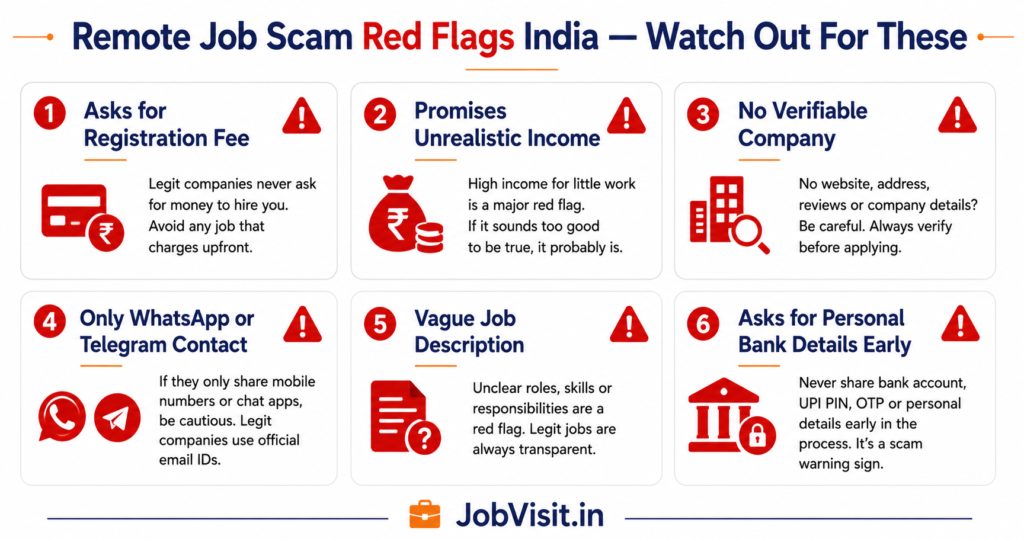
Red Flag 1 — They Ask You to Pay Anything
This is the clearest and most absolute signal. Legitimate employers pay you — you never pay them. No registration fee. No training fee. No equipment deposit. No security deposit.
If any “employer” asks for any amount of money before your first payment from them — stop immediately. This is a scam regardless of how professional the communication looks or how convincing the explanation sounds.
Red Flag 2 — The Income Promise Is Unrealistic
Any work from home opportunity promising ₹30,000 to ₹80,000 per month to a fresher with no experience — doing simple tasks like data entry, form filling, or ad clicking — is not real.
Legitimate entry-level remote work in India pays ₹8,000 to ₹25,000 per month. It increases with experience, skill development, and client relationships over time. It does not start at ₹50,000 for someone with no experience doing simple tasks.
When an income promise sounds too good to be true for the effort described — it is.
Red Flag 3 — No Verifiable Company Exists
Before pursuing any remote job opportunity in India — search for the company independently.

Go to Google and search the company name. Does a professional website exist? Is the website recently created or does it have years of content? Does the company appear on LinkedIn with real employees? Is there any news or review content about them? Do Glassdoor or AmbitionBox have any employee reviews?
A legitimate company has a discoverable professional presence. A scam operation typically has a freshly created website with stock images, no employees on LinkedIn, and no independent reviews anywhere.
Red Flag 4 — Contact Is Only Through WhatsApp or Telegram
Legitimate employers have professional email addresses at their company domain — not Gmail, Yahoo, or Hotmail addresses. They have phone numbers listed on their website. They communicate through professional channels.
Scam operations almost always conduct their entire recruitment through WhatsApp or Telegram because these channels are harder to trace and easier to abandon quickly.
If a “recruiter” refuses to communicate through email or a professional platform and insists on WhatsApp only — do not proceed.
Red Flag 5 — The Job Description Is Vague or Makes No Sense
Legitimate jobs describe specific work — enter data from these documents into this system, write articles of this type for this website, provide customer support for this product through this channel.
Scam job descriptions describe vague activities that sound like work but do not actually describe anything specific — “online work from home,” “simple tasks,” “part-time work — flexible hours,” “earn money by completing easy assignments.”
If reading a job description twice still leaves you unclear about what you would actually be doing daily — that is either a scam or a genuinely poor employer worth avoiding.
Red Flag 6 — They Ask for Sensitive Personal Information Too Early
Aadhar number, PAN number, bank account details, and personal photographs are required by legitimate employers eventually — for tax and payment purposes after you are hired and working.
They are not required during the application process. Any employer asking for your Aadhar number or bank account details before you have completed any work and before any formal employment documentation is suspicious.
Trusted Platforms to Find Genuine Remote Jobs in India
The most reliable platform for legitimate remote job opportunities from both Indian and international companies. Use the job search with location filter set to “Remote” and your target role title. Set up email job alerts so new remote postings reach you automatically.
LinkedIn also allows you to verify companies easily — every legitimate company has a company page with employee profiles, company information, and posting history.
How to Use LinkedIn Remote Job Search Effectively
Search specifically rather than broadly. “Remote content writer India” produces better results than just “work from home.” Use the “Easy Apply” filter to find roles you can apply to directly on the platform. Check how recently the job was posted — apply to listings posted within the last seven days for the best response rates.
Internshala
Internshala is specifically focused on Indian students and freshers and has a work from home section with verified remote internships and entry-level roles from Indian companies.
The platform verifies the companies it lists which significantly reduces scam risk compared to general classifieds. Remote opportunities on Internshala include content writing, data entry, social media management, digital marketing, virtual assistance, and customer support — all legitimate categories with real companies behind them.
Naukri Remote Job Filter
Naukri has a work from home filter that surfaces remote listings from Indian companies. The platform is well-established and companies listing on Naukri are generally verifiable. Use the filter specifically rather than browsing general listings to find remote-specific roles.
Upwork
Upwork is the largest international freelancing platform and has a significant market of clients specifically looking for Indian remote workers for data entry, content writing, virtual assistance, customer support, and various technical roles.
The platform has strong verification systems for both clients and freelancers. Payments are held in escrow and released only after work is approved — protecting you from non-payment scams that are common with direct client relationships outside platforms.
Fiverr
Fiverr works differently from Upwork — you create service listings and clients come to you rather than you applying to job postings. This works well for specific skill-based remote work like content writing, design, data entry, and video subtitling.
Fiverr has strong payment protection and a clear review system that builds credibility over time. Starting income is low but consistent quality work on Fiverr compounds into a reliable income stream over 3 to 6 months.
How to Verify a Company Before Applying
This process takes five minutes and protects you from most scam attempts.
Search the company name on Google independently — not through the link they sent you. Visit the website directly through your own search. Check that the website looks professional, has real content, and was not recently created.
Search the company name on LinkedIn. Does a company page exist? Are there real employees listed? Do the employees have complete profiles with work history or do they look like fake accounts?
Search the company name plus “review” or “scam” on Google. AmbitionBox, Glassdoor, and general Google search results will surface any negative patterns if they exist.
Check if the recruiter’s email address matches the company domain. A recruiter from TechCorp India should have an email ending in @techcorpindia.com — not @gmail.com or a variation of the company name at a free email service.
If all four checks come back clean — the opportunity is likely legitimate. If any check raises a question — ask the recruiter directly and evaluate whether their response is clear and professional.
What to Do If You Encounter a Scam
If you identify a scam or have been targeted by one — report it.
Report to the National Cyber Crime Reporting Portal at cybercrime.gov.in. This portal specifically handles online fraud complaints in India including work from home scams.
If you have already paid money to a scammer — file a complaint with your local police cyber crime cell immediately rather than waiting. The sooner the complaint is filed the better the chances of any investigation or recovery.
Share information about specific scam operations in the job seeker communities and groups you are part of. Warning others costs you nothing and may save someone else from losing money.
Building a Safe Remote Work Income in India
The remote work opportunity in India in 2026 is real. Companies are hiring remotely more than ever before. International clients are actively seeking Indian remote workers. The platforms to connect with legitimate work have never been more accessible.
The path to genuine remote income requires patience that scam ads never ask for. It starts small. It builds through consistent quality work and developing a reputation on legitimate platforms. It produces stable income over 3 to 6 months of sustained effort.
That timeline is slower than what scam ads promise. It is also real — which is the only kind of income that actually helps you.