How Much Can You Realistically Earn Working From Home in India
Let us start with the number you have probably seen advertised somewhere.
₹50,000 per month working from home. No experience needed. Just a laptop and wifi.
That number is not impossible. It is also not what most people earn when they start working from home in India. The gap between that advertised number and the reality of what freshers and beginners actually earn in their first few months of remote work is significant — and nobody who is trying to sell you something is going to close that gap honestly.
This guide does.
What follows is an honest, detailed picture of what working from home in India actually pays in 2026 — by role, by experience level, by whether you are working part time or full time, and what the realistic growth trajectory looks like over one to two years of consistent effort.
Why Honest Income Expectations Matter Before You Start
Starting any work from home role with unrealistic income expectations causes two specific problems.
The first problem is quitting too early. A fresher who expects ₹30,000 per month from day one and earns ₹4,000 in their first month concludes that remote work does not work and gives up — right before the point where consistent effort starts producing real results.
The second problem is making bad financial decisions. A fresher who counts on ₹25,000 per month of WFH income before they have actually built it — making decisions about rent, purchases, or financial commitments based on that expected income — creates real problems when month two produces ₹6,000 instead.
Honest expectations prevent both of these outcomes. You know what to expect. You plan accordingly. You push through the slow start without giving up or making unsustainable financial decisions.
The Two Types of Work From Home Income in India
Before getting into specific numbers, understand the fundamental difference between the two types of remote income in India.
Salaried Remote Employment
This is when an Indian company hires you as an employee — with a fixed monthly salary — but you work from home rather than coming into an office. The salary is fixed, predictable, and paid on a specific date every month regardless of how much work you produced that day.
Remote customer support executive roles, remote data entry positions at established companies, and remote operations roles at tech companies are typically structured this way.
Starting salary for salaried remote employment for freshers in India ranges from ₹12,000 to ₹22,000 per month. This is the most financially stable form of WFH income and is closest to a traditional job in terms of income predictability.
Freelance Remote Income
This is when you work project-by-project or client-by-client — content writing, data entry gigs, virtual assistant work, design, tutoring — and your income directly reflects how much work you find and complete each month.
Freelance income is highly variable especially at the start. Month one might produce ₹2,000. Month three might produce ₹12,000. Month eight might produce ₹28,000. The ceiling is higher than salaried employment over time but the floor in the early months is also much lower.
Most freshers starting WFH in India are in the freelance category because salaried remote jobs have more competition and typically require demonstrable experience or skills.

Realistic Income by Role — What You Actually Earn in India
Data Entry — Remote
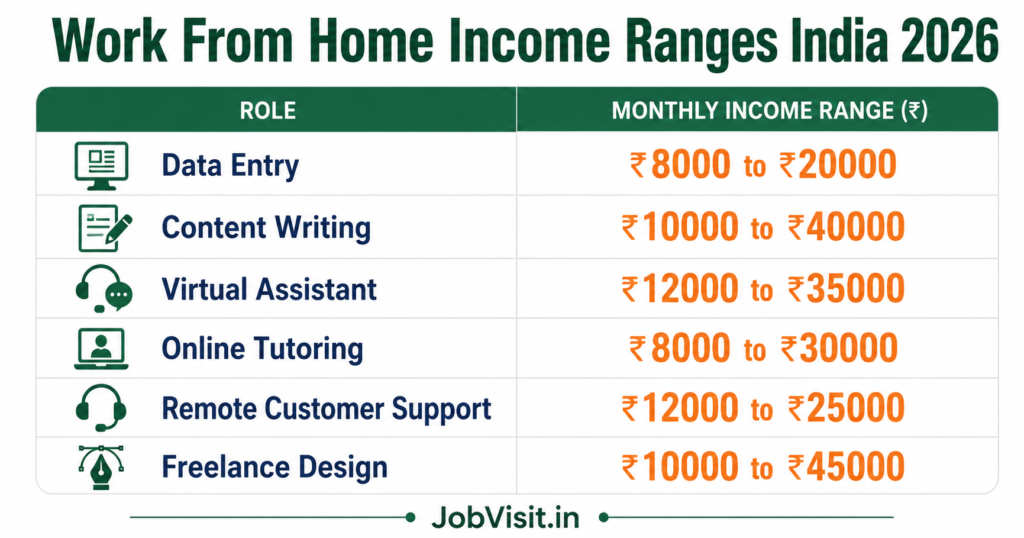
Month 1 to 2: ₹2,000 to ₹6,000 Month 3 to 6: ₹8,000 to ₹15,000 Month 6 to 12: ₹12,000 to ₹22,000 Experienced freelancer: ₹18,000 to ₹30,000
Data entry starts slow because building a profile with reviews on platforms like Upwork or Fiverr takes time. The first few orders come at very low rates to attract initial clients. After 10 to 15 completed orders with good reviews, rates can be raised and income grows more predictably.
The ceiling for pure data entry is moderate — it is a commodity service and pricing is competitive. Freshers who start with data entry and add related skills — Excel analysis, database management, basic SQL — move into higher-paying data operations roles within 6 to 12 months.
Content Writing — Remote
Month 1 to 2: ₹2,000 to ₹8,000 Month 3 to 6: ₹10,000 to ₹22,000 Month 6 to 12: ₹18,000 to ₹35,000 Experienced writer with niche expertise: ₹30,000 to ₹60,000 plus
Content writing has one of the highest income ceilings of any accessible remote role for Indian freshers — but also one of the slowest starts.
The slow start happens because new writers spend the first two months building portfolio samples, getting first clients at very low rates, and developing the speed needed to produce content profitably. Writing 800 words for ₹200 in the first month is demoralizing but it is the reality for most beginners.
The growth after that initial period is steeper than most other remote roles because writing quality compounds — each article makes you faster and better, clients who are happy come back with more work, and your per-word or per-article rate can increase significantly as your profile builds.
What Separates High-Earning Content Writers in India From Average Ones
Niche specialization. A generalist content writer in India earns moderate rates. A writer who specializes in finance, technology, healthcare, legal content, or e-commerce product descriptions — and can demonstrate expertise in that specific area — commands significantly higher rates because fewer writers can credibly fill that need.
Virtual Assistant — Remote
Month 1 to 2: ₹5,000 to ₹12,000 Month 3 to 6: ₹12,000 to ₹22,000 Month 6 to 12: ₹20,000 to ₹35,000 Experienced VA with multiple clients: ₹30,000 to ₹55,000
Virtual assistant income grows faster than data entry or content writing for one specific reason — it is relationship-based. A VA who does good work for one client is very likely to keep that client for months or years. Retainer-based VA relationships — where a client pays a fixed monthly fee for a set number of hours — create the most financially stable form of freelance income available to Indian remote workers.
International clients through Upwork or OnlineJobs.ph pay significantly more than Indian clients for VA work — often ₹400 to ₹700 per hour versus ₹150 to ₹300 per hour from Indian employers. Building even two or three stable international VA clients produces an income that is genuinely life-changing for a fresher from a smaller Indian city.
Online Tutoring — Remote
Month 1 to 2: ₹3,000 to ₹10,000 Month 3 to 6: ₹10,000 to ₹20,000 Month 6 to 12: ₹15,000 to ₹35,000 Established tutor with regular students: ₹25,000 to ₹50,000
Tutoring income depends heavily on the subject and the level being taught. A tutor helping school students with basic subjects earns less per hour than a tutor coaching competitive exam aspirants for JEE, NEET, UPSC, or IBPS.
Per-session rates in India for online tutoring range from ₹200 to ₹800 per hour depending on subject, level, and whether you are working through a platform or directly with students. Working directly with students — acquired through word of mouth or local referrals — pays more than platform rates since platforms take a significant commission.
The Long-Term Tutoring Income Model
Tutors who build a consistent base of 15 to 20 regular weekly students — each attending 2 to 4 sessions per month — create a genuinely stable monthly income that grows predictably through referrals rather than requiring constant new client acquisition.
Remote Customer Support — Salaried
Starting salary: ₹12,000 to ₹18,000 per month After 6 months: ₹15,000 to ₹22,000 per month After 1 year with good performance: ₹18,000 to ₹28,000 per month

Remote customer support is the most immediately stable WFH income for freshers because it is salaried employment rather than freelance. You know exactly what you will earn every month from day one.
The trade-off is a lower ceiling compared to freelance roles — salary increments are periodic and modest rather than directly reflecting the hours or quality of your work.
Freelance Design Using Canva — Remote
Month 1 to 2: ₹3,000 to ₹8,000 Month 3 to 6: ₹10,000 to ₹22,000 Month 6 to 12: ₹18,000 to ₹40,000 Experienced designer with consistent clients: ₹30,000 to ₹60,000
Freelance design through Canva for social media graphics, presentations, and marketing materials has grown significantly as a remote income source for Indian freshers. Small Indian businesses — Instagram sellers, local service providers, small e-commerce shops — have ongoing graphic needs and limited budgets that make Canva-skilled designers an attractive option.
The income ceiling for Canva-based design work is moderate compared to professional graphic designers using advanced software — but it is entirely accessible to freshers with two to three weeks of focused Canva learning and practice.
Part Time vs Full Time WFH — Income Comparison
Many freshers start WFH work part time while also job searching or studying. Here is how income differs between the two approaches.
| Approach | Monthly Hours | Typical Monthly Income Range |
|---|---|---|
| Part time — 10 to 15 hours per week | 40 to 60 hours | ₹4,000 to ₹12,000 |
| Half time — 20 to 25 hours per week | 80 to 100 hours | ₹8,000 to ₹20,000 |
| Full time — 35 to 40 hours per week | 140 to 160 hours | ₹15,000 to ₹40,000 |
Part time WFH income is genuinely useful as a supplement to other activity — job searching, exam preparation, college. It covers daily expenses and builds a portfolio simultaneously. It rarely replaces a full-time income until you have been doing it consistently for 6 to 12 months.
How to Grow Your WFH Income Over Time in India
Month 1 to 3 — The Foundation Phase
Focus entirely on quality rather than quantity. Take every piece of work seriously regardless of how small the payment. Build your first reviews or testimonials. Do not spread across multiple platforms — master one.
Month 3 to 6 — The Growth Phase
Start raising rates gradually as your review count builds. Begin approaching clients directly in addition to platform work. Identify your strongest skill area and deepen expertise there rather than trying to offer everything.
Month 6 to 12 — The Stability Phase
Start building retainer relationships with good clients — offer monthly packages rather than per-project rates. Begin transitioning from platforms to direct client relationships where possible since platform commission fees reduce your effective income by 10 to 20 percent.
Year 2 Plus — The Scale Phase
Specialization produces the biggest income jumps at this stage. A content writer who becomes the go-to person for financial content, or a virtual assistant who specializes in e-commerce business support, commands rates that a generalist simply cannot access. Invest in one area of genuine depth and let that specialization drive income growth.
One Honest Comparison — WFH vs Entry Level Office Job in India
This question deserves a direct answer.
| Factor | Entry Level Office Job | Work From Home Freelance |
|---|---|---|
| Month 1 Income | ₹12,000 to ₹20,000 fixed | ₹2,000 to ₹8,000 variable |
| Month 12 Income | ₹14,000 to ₹22,000 | ₹20,000 to ₹45,000 possible |
| Income Stability | High | Low initially, grows over time |
| Growth Ceiling | Moderate | Higher with right skills |
| Professional Experience | Strong — builds resume | Builds portfolio but not traditional experience |
| Location Freedom | Low | High |
For most freshers in India the honest recommendation is not either-or. Take an entry-level office job if one becomes available — it provides immediate stable income and professional experience. Build WFH freelance income simultaneously — it creates financial security that makes you less dependent on any single employer and builds skills that grow in value over time.
The combination of both — a job for stability and freelancing for growth — is the most financially resilient path for Indian freshers in 2026.